
NewTry UBQ Quiz Lab. 40+ custom built quizzes to get a 5 on AP Physics 1.
for free to use all UBQ features
An airliner arrives at the terminal, and the engines are shut off. The rotor of one of the engines has an initial clockwise angular velocity of \( 2000 \) \( \text{rad/s} \). The engine’s rotation slows with an angular acceleration of magnitude \( 80.0 \) \( \text{rad/s}^2 \).
Late one morning, a mosquito collides with the windshield of a speeding truck. The force of the truck on the mosquito is ____ the force of the mosquito on the truck; the resulting acceleration of the mosquito is ____ the acceleration of the truck.
A block starts from rest at the top of a \(50^\circ\) incline. The coefficient of kinetic friction between the block and the incline is \(0.4\). If the block reaches a velocity of \(7 \, \text{m/s}\) at the bottom of the incline, what is the length of the incline?

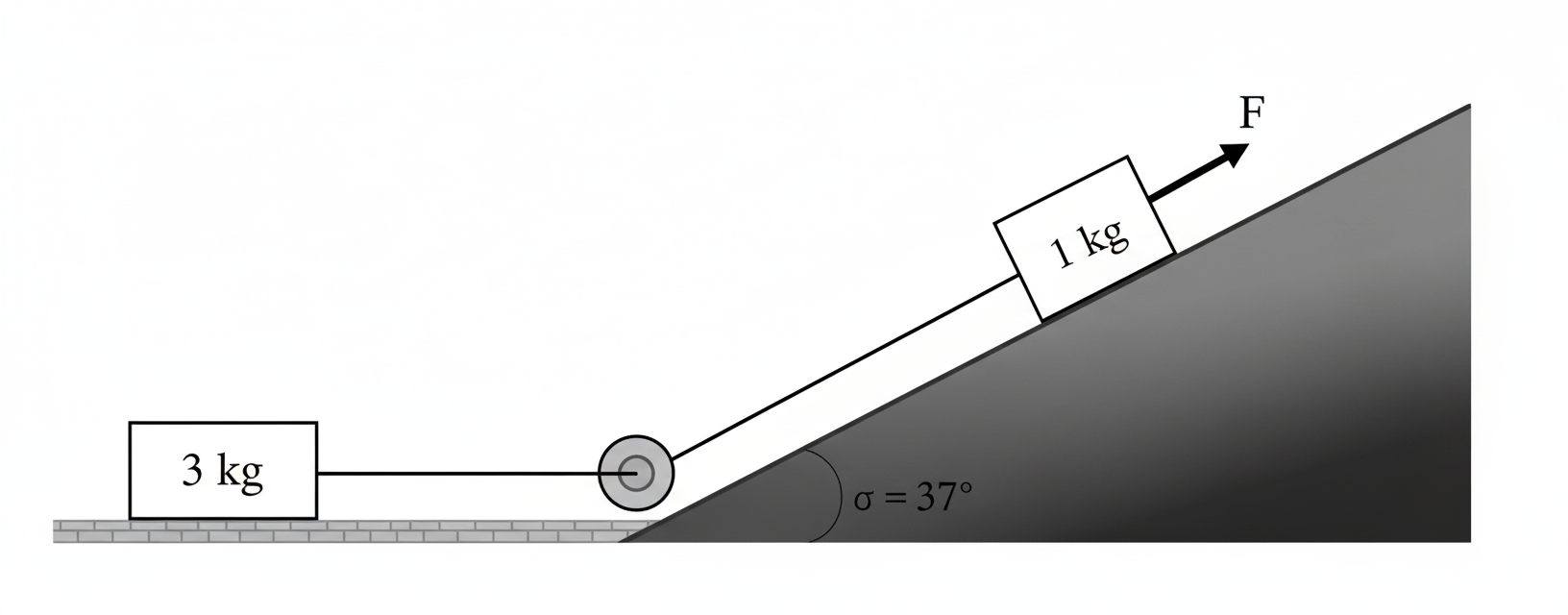
A \( 1 \) \( \text{kg} \) mass on a \( 37^{\circ} \) incline is connected to a \( 3.0 \) \( \text{kg} \) mass on a horizontal surface, as shown. The surfaces and the pulley are frictionless. If \( F = 12 \) \( \text{N} \):
A mass–spring system is oscillating in simple harmonic motion. At the exact moment the mass passes through its equilibrium position, which of the following statements is true?
A group of astronauts in a spaceship are attempting to land on Mars. As they approach the planet, they begin to plan their descent to the surface.

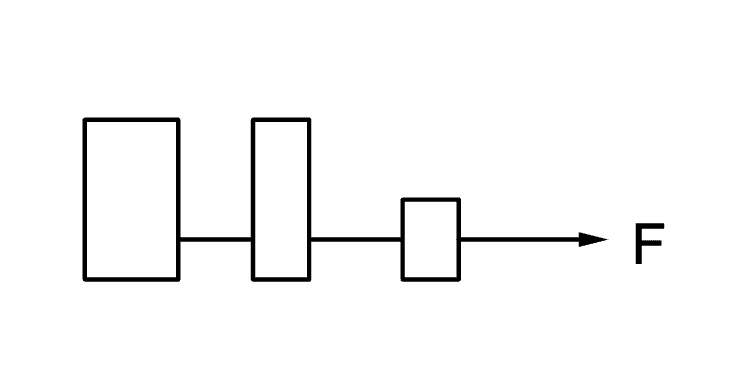
Shown above are three masses of \(6 \, \text{kg}\), \(3 \, \text{kg}\), and \(1 \, \text{kg}\) (in order from left to right). You pull on the 1kg mass with a force \(F\) of \(15 \, \text{N}\) along a frictionless surface.
In archery, should the arrow be aimed directly at the target? How should your angle of aim depend on the distance to the target? Explain without using equations.
On a harsh winter day, a \( 1500 \) \( \text{kg} \) vehicle takes a circular banked exit ramp (radius \( R = 150 \) \( \text{m} \); banking angle of \( 10^\circ \)) at a speed of \( 30 \) \( \text{mph} \), since the speed limit is \( 35 \) \( \text{mph} \). However, the exit ramp is completely iced up (frictionless). To make matters worse, a wind is blowing parallel to the ramp in a downward direction. The wind exerts a force of \( 3000 \) \( \text{N} \). Under these conditions, can the driver continue to follow a safe horizontal circle on the exit ramp and stay below the speed limit?
To convert \( \text{mph} \) into \( \text{m/s} \), use \( 1 \) \( \text{mi} = 1607 \) \( \text{m} \) and \( 1 \) \( \text{hr} = 3600 \) \( \text{s} \).
A space probe far from the Earth is traveling at 14.8 km/s. It has mass 1312 kg. The probe fires its rockets to give a constant thrust of 156 kN for 220 seconds. It accelerates in the same direction as its initial velocity. In this time it burns 150 kg of fuel. Calculate final speed of the space probe in km/s.
Note: This is a bonus question. Skip if you haven’t yet taken calculus.
A person’s center of mass is easily found by having the person lie on a reaction board. A horizontal, \( 2.3 \) \( \text{m} \)-long, \( 6.1 \) \( \text{kg} \) reaction board is supported only at the ends, with one end resting on a scale and the other on a pivot. A \( 64 \) \( \text{kg} \) woman lies on the reaction board with her feet over the pivot. The scale reads \( 27 \) \( \text{kg} \). What is the distance from the woman’s feet to her center of mass? Express your answer with the appropriate units.
A small boat coasts at constant speed under a bridge. A heavy sack of sand is dropped from the bridge onto the boat. The speed of the boat
An elastic cord is \( 80\) \( \text{cm} \) long when it is supporting a mass of \( 10. \) \( \text{kg} \) hanging from it at rest. When an additional \( 4.0 \) \( \text{kg} \) is added, the cord is \( 82.5 \) \( \text{cm} \) long.
A block of mass \( m \) is attached to a horizontal spring with spring constant \( k \) and undergoes simple harmonic motion with amplitude \( A \) along the \( x \)-axis. Which of the following equations could represent the position \( x \) of the object as a function of time?
If the acceleration of an object is \( 0 \), are no forces acting on it? Explain.
You are working out on a rowing machine. Each time you pull the rowing bar toward you, it moves a distance of \(1.25 \, \text{m}\) in a time of \(0.84 \, \text{s}\). The readout on the display indicates that the average power you are producing is \(76 \, \text{W}\). What is the magnitude of the force that you exert on the handle?
A projectile is launched at an upward angle of \( 30^\circ \) to the horizontal with a speed of \( 30 \) \( \text{m/s} \). How does the horizontal component of its velocity \( 1.0 \) \( \text{s} \) after launch compare with its horizontal component of velocity \( 2.0 \) \( \text{s} \) after launch, ignoring air resistance?

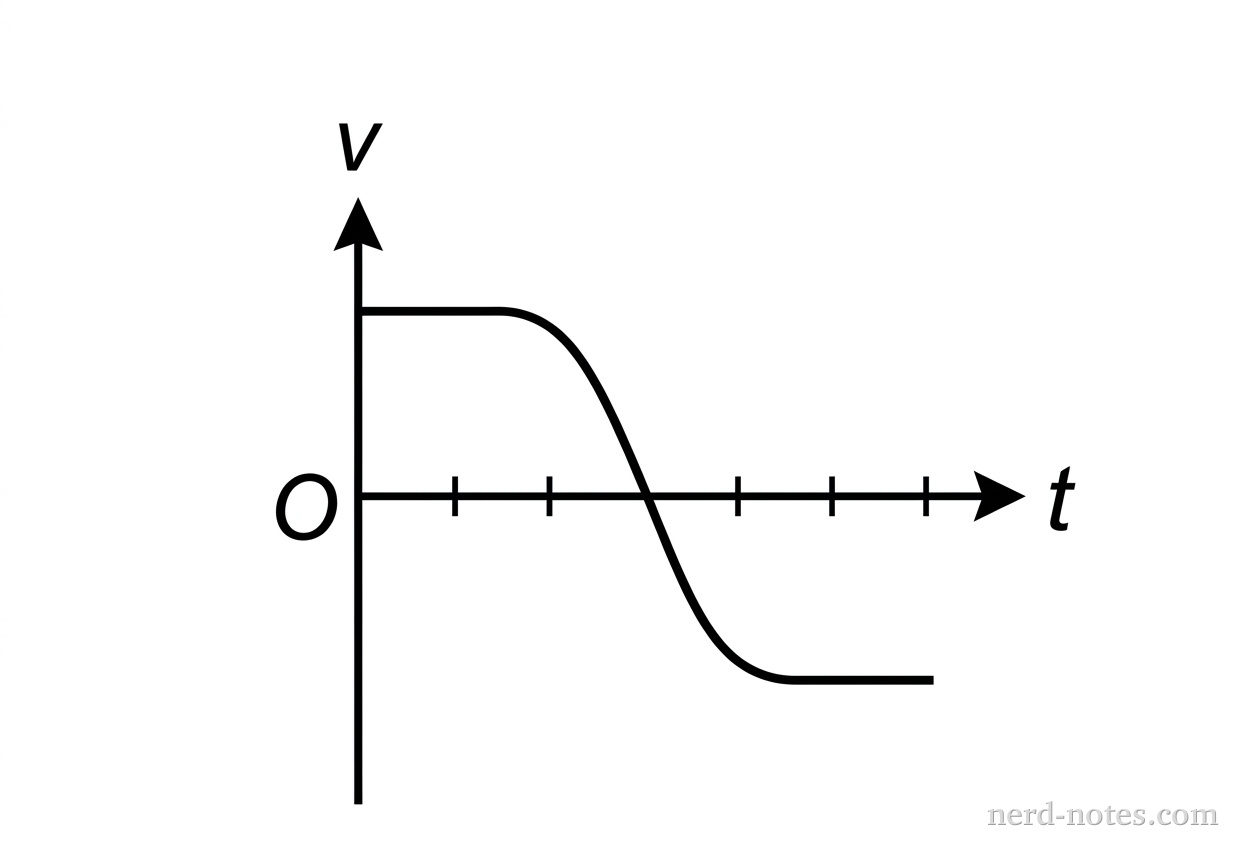
The graph above shows velocity \( v \) versus time \( t \) for an object in linear motion. Which of the following is a possible graph of position (\( x \)) versus time (\( t \)) for this object?

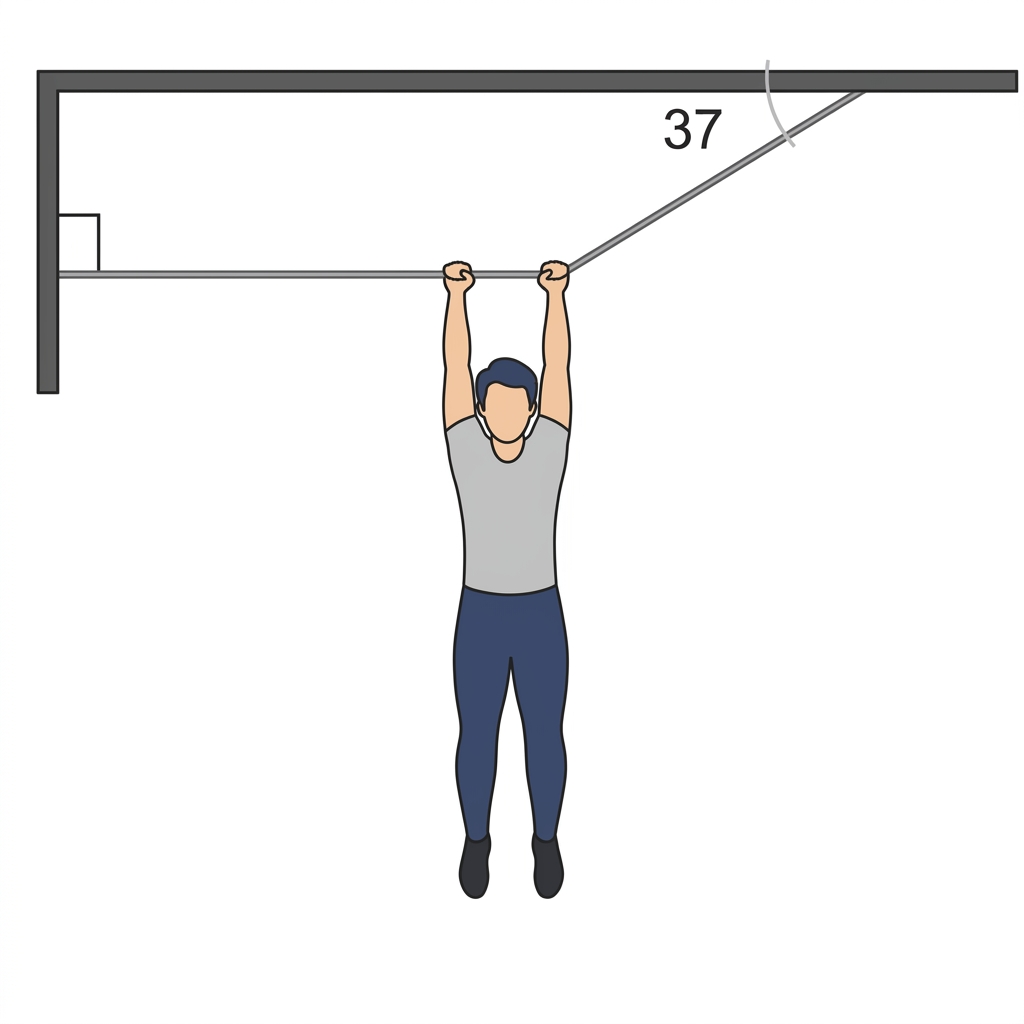
Find the tension in each cable supporting the gymnast who weighs \( 600 \) \( \text{N} \). The gymnast is at rest, holding a junction point where two cables are attached: one cable is horizontal, and the second cable is attached to the ceiling making an angle of \( 37^{\circ} \) above the horizontal, as shown in the diagram.
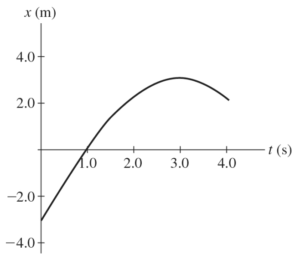
The graph in the figure shows the position of a particle as it travels along the x-axis. At what value of \(t\) is the speed of the particle equal to \(0 \, \text{m/s}\)?
note that the slope of position vs time is velocity. And the graph most closely reemsbles a flat or 0 slope at 3 seconds

In the laboratory, you are given a cylindrical beaker containing a fluid and you are asked to determine the density \( \rho \) of the fluid. You are to use a spring of negligible mass and unknown spring constant \( k \) that is attached to a vertical stand.
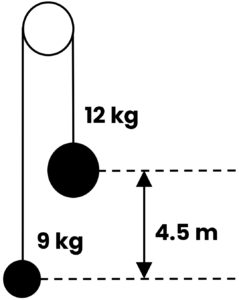
Using only work and energy, find the velocity of the masses after they have traveled \(0.8 \, \text{m}\). Refer to the image above.
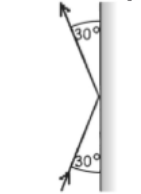
A super dart of mass \(20 \, \text{g}\), traveling at \(350 \, \text{m/s}\), strikes a steel plate at an angle of \(30^\circ\) with the plane of the plate, as shown in the figure. It bounces off the plate at the same angle but at a speed of \(320 \, \text{m/s}\). What is the magnitude of the impulse that the plate gives to the bullet?
An eagle is flying horizontally at \(6 \, \text{m/s}\) with a fish in its claws. It accidentally drops the fish.
By continuing you (1) agree to our Terms of Use and Terms of Sale and (2) consent to sharing your IP and browser information used by this site’s security protocols as outlined in our Privacy Policy.
One price to unlock most advanced version of Phy across all our tools.
per month
Billed Monthly. Cancel Anytime.
Quick Start Guide
AP physics 1, AP C, honors and advanced physics students.
Quickly filter questions by units and more.
Here’s guide to using 5 UBQ filters.
GQ = general question, MCQ = multiple choice, FRQ = free response.
Click the check or bookmark button.
Now you’ll be able to see completed or bookmarked questions at a glance!
Answer keys, personalized for you.
Phy will be responsible for grading your FRQs and GQs.
No more copy and pasting. Just solve and snap.
Questions for Mastery
By continuing you agree to nerd-notes.com Terms of Service, Privacy Policy, and our usage of user data.