
NewTry UBQ Quiz Lab. 40+ custom built quizzes to get a 5 on AP Physics 1.
for free to use all UBQ features
A merry-go-round spins freely when Diego moves quickly to the center along a radius of the merry-go-round. As he does this, it is true to say that
A student kicks a soccer ball. The ball exerts a force back on the student’s foot. Why doesn’t the student’s foot accelerate backward as much as the ball accelerates forward?
Mary and Sally are in a foot race. When Mary is \( 22 \) \( \text{m} \) from the finish line, she has a speed of \( 4.0 \) \( \text{m/s} \) and is \( 5.0 \) \( \text{m} \) behind Sally, who has a speed of \( 5.0 \) \( \text{m/s} \). Sally thinks she has an easy win and, during the remaining portion of the race, decelerates at a constant rate of \( 0.40 \) \( \text{m/s}^2 \) until she reaches the finish line. What constant acceleration must Mary maintain during the remaining portion of the race if she wishes to cross the finish line side-by-side with Sally?
A satellite in circular orbit around the Earth moves at constant speed. This orbit is maintained by the force of gravity between the Earth and the satellite, yet no work is done on the satellite. How is this possible?

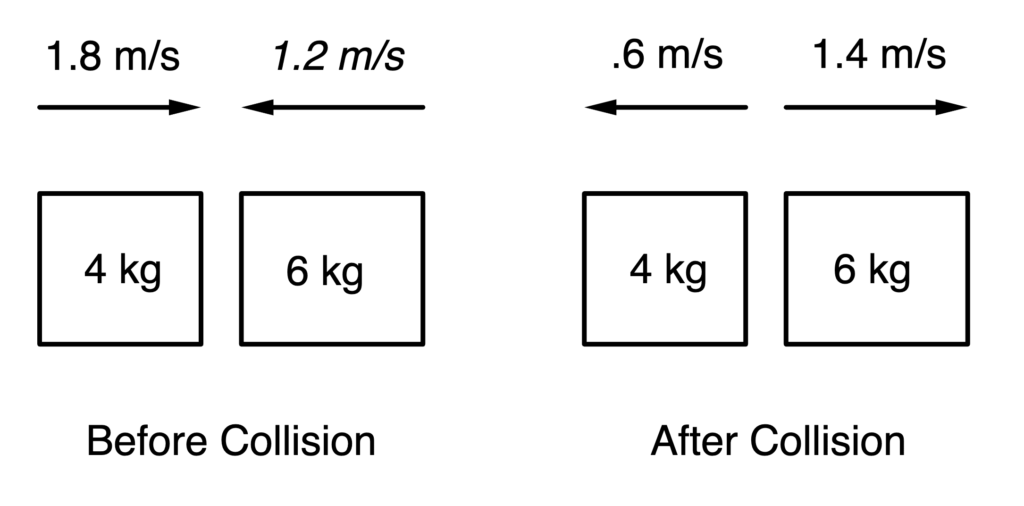
From the figure above, determine which characteristic fits this collision best.
A centrifuge in a medical laboratory is rotating at an angular speed of \( 3600 \) \( \text{rev/min} \). When switched off, it rotates \( 50.0 \) times before coming to rest. Find the constant angular deceleration of the centrifuge.

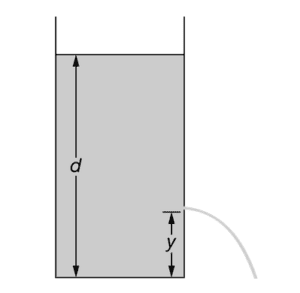
The figure shows a container filled with water to a depth \( d \). The container has a hole a distance \( y \) above its bottom, allowing water to exit with an initially horizontal velocity. Which of the following correctly predicts and explains how the speed of the water as it exits the hole would change if the distance \( y \) above the bottom of the container increased?
A car travels at \( 20 \, \text{m/s} \) for \( 5 \, \text{mins} \) and then travels another \( 2 \, \text{km} \) at \( 40 \, \text{m/s} \). What is the total distance traveled and time of travel for the car?
In which one of the following circumstances does the principle of conservation of mechanical energy apply, even though a nonconservative force acts on the moving object?
A \(4.0 \, \text{kg}\) block is moving at \(5.0 \, \text{m/s}\) along a horizontal frictionless surface toward an ideal spring that is attached to a wall. After the block collides with the spring, the spring is compressed a maximum distance of \(0.68 \, \text{m}\). What is the speed of the block when the spring is compressed to only one-half of the maximum distance?
An object moves at a constant speed of \( 9.0 \frac{m}{s} \) in a circular path of radius of 1.5 m. What is the angular acceleration of the object?
A “doomsday” asteroid with a mass of \( 1010 \, \text{kg} \) is hurtling through space. Unless the asteroid’s speed is changed by about \( 0.20 \, \text{cm/s} \), it will collide with Earth and cause tremendous damage. Researchers suggest that a small “space tug” sent to the asteroid’s surface could exert a gentle constant force of \( 2.5 \, \text{N} \). For how long must this force act?
Toy car W travels across a horizontal surface with an acceleration of \( a_w \) after starting from rest. Toy car Z travels across the same surface toward car W with an acceleration of \( a_z \), after starting from rest. Car W is separated from car Z by a distance \( d \). Which of the following pairs of equations could be used to determine the location on the horizontal surface where the two cars will meet, and why?
| Speed | \( 10 \, \mathrm{m/s} \) | \( 20 \, \mathrm{m/s} \) | \( 30 \, \mathrm{m/s} \) |
| Braking Distance | \( 6.1 \, \mathrm{m} \) | \( 23.9 \, \mathrm{m} \) | \( 53.5 \, \mathrm{m} \) |
A car of mass \( 1500 \, \mathrm{kg} \) is traveling at one of the speeds listed when the brakes are first applied. Using the data above, what is the magnitude of the average braking force required to stop the car?
A car accelerates from \( 0 \) to \( 25 \) \( \text{m/s} \) in \( 5 \) \( \text{s} \). If the car’s tires have a diameter of \( 70 \) \( \text{cm} \), how many revolutions does a tire make while accelerating?
A projectile is launched at a speed of \( 22 \) \( \text{m/s} \) at an angle of \( 60^{\circ} \) above the horizontal. It lands on a ramp that is \( 5 \) \( \text{m} \) lower than the launch height. How long does it take for the projectile to hit the ramp?

A simple pendulum oscillates with amplitude \(A\) and period \(T\), as represented on the graph above. Which option best represents the magnitude of the pendulum’s velocity \(v\) and acceleration \(a\) at time \(\frac{T}{2}\)?
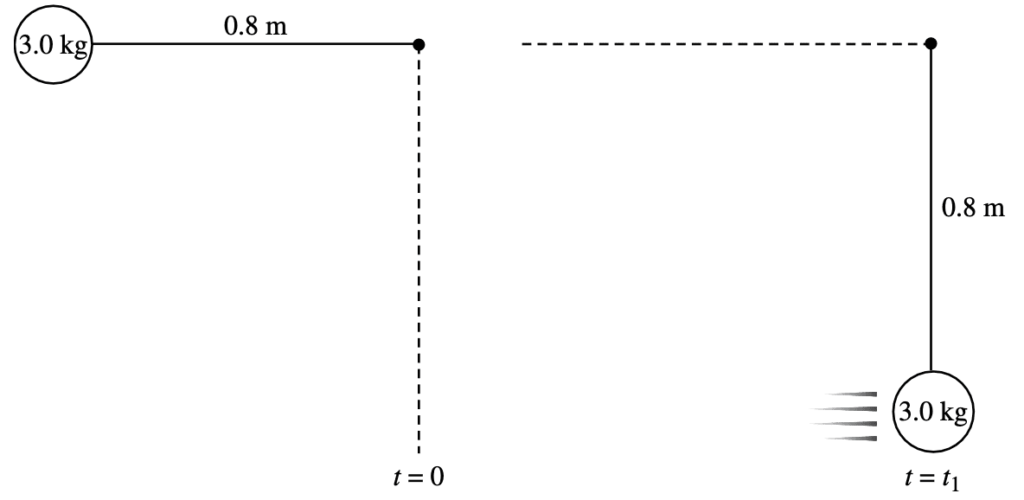
An object of mass \( m = 3.0 \) \( \text{kg} \) is attached to one end of a string with negligible mass and length \( L = 0.80 \) \( \text{m} \). The object is released from rest at time \( t = 0 \), when the string is horizontal. At time \( t = t_1 \) the object is at the location shown in the figure, where the string is vertical. Which of the following is most nearly the magnitude of the tension in the string at time \( t = t_1 \)?

Projectiles 1 and 2 are launched from level ground at the same time and follow the trajectories shown in the figure. Which one of the projectiles, if either, returns to the ground first, and why?
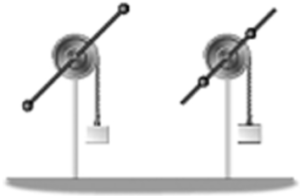
The rotating systems, shown in the figure above, differ only in that the two identical movable masses are positioned a distance r from the axis of rotation (left), or a distance r/2 from the axis of rotation (right). What happens if you release the hanging blocks simultaneously from rest?
The efficiency of a pulley system is 55%. The
pulleys are used to raise a mass of 90.0 kg to a height of
5.60 m. What force is exerted on the rope of the pulley
system if the rope is pulled for 22 m in order to raise
the mass to the required height?
The driver of a car traveling at \( 30.0 \) \( \text{m/s} \) applies the brakes and undergoes a constant negative acceleration of \( 2.00 \) \( \text{m/s}^2 \). How many revolutions does each tire make before the car comes to a stop, assuming that the car does not skid and that the tires have radii of \( 0.300 \) \( \text{m} \)?
A small sphere hangs from a string attached to the ceiling of a uniformly accelerating train car. It is observed that the string makes an angle of \(37^\circ\) with respect to the vertical. The magnitude of the acceleration \(a\) of the train car is most nearly:
The distance from earth to sun is \(1 \, \text{AU}\). The distance from Saturn to sun is \(9 \, \text{AU}\). Find the period of Saturn’s orbit in years. You can assume that the orbits are circular.
By continuing you (1) agree to our Terms of Use and Terms of Sale and (2) consent to sharing your IP and browser information used by this site’s security protocols as outlined in our Privacy Policy.
One price to unlock most advanced version of Phy across all our tools.
per month
Billed Monthly. Cancel Anytime.
Quick Start Guide
AP physics 1, AP C, honors and advanced physics students.
Quickly filter questions by units and more.
Here’s guide to using 5 UBQ filters.
GQ = general question, MCQ = multiple choice, FRQ = free response.
Click the check or bookmark button.
Now you’ll be able to see completed or bookmarked questions at a glance!
Answer keys, personalized for you.
Phy will be responsible for grading your FRQs and GQs.
No more copy and pasting. Just solve and snap.
Questions for Mastery
By continuing you agree to nerd-notes.com Terms of Service, Privacy Policy, and our usage of user data.