for free to use all UBQ features
A ball is tossed directly upward. Its total time in the air is \( T \). Its maximum height is \( H \). What is its height after it has been in the air a time \( T/4 \)? Air resistance is negligible.
A meter stick of mass 200 grams is balanced at the 40-cm mark when a 100-gram mass is suspended from the 10-cm mark. What is the distance from the pivot point to the center of mass of the meter stick? Give your answer in centimeters.
A ball is kicked at a speed of \( v_0 \) at an angle \( \theta \) above the horizontal. The ball travels 25 meters horizontally. If the ball is kicked at \( 2v_0 \), what will the horizontal displacement be?
If you want to double the momentum of a gas molecule, by what factor must you increase its kinetic energy?
What is the mass of a dog that weighs \(58 \, \text{N}\) on Earth?
Initially, a ball has an angular velocity of \( 5.0 \) \( \text{rad/s} \) counterclockwise. Some time later, after rotating through a total angle of \( 5.5 \) \( \text{radians} \), the ball has an angular velocity of \( 1.5 \) \( \text{rad/s} \) clockwise.
A \( 200 \)\( \text{ lb} \) block is resting on a \( 30^{\circ} \) incline. The coefficient of static friction between the block and the plane is \( \mu_s = 0.8 \). Will the block remain at rest?
Why do you need to “pump” your legs when you begin swinging on a park swing?
A ball is dropped from the top of a tall building. At the same instant, a second ball is thrown upward from the ground level. When the two balls pass one another, one on the way up, the other on the way down, compare the magnitudes of their acceleration:

A ball of mass \(m\) is released from rest at a distance \(h\) above a frictionless plane inclined at an angle of \(45^\circ\) to the horizontal as shown above. The ball bounces horizontally off the plane at point \(P_1\) with the same speed with which it struck the plane and strikes the plane again at point \(P_2\). In terms of \(g\) and \(h\), determine each of the following quantities:
A 0.72-m-diameter solid sphere can be rotated about an axis through its center by a torque of 10.8 N·m which accelerates it uniformly from rest through a total of 160 revolutions in 15.0 s. What is the mass of the sphere?
You throw a rock straight up with an initial velocity of \( 5.0 \, \text{m/s} \).
In \(3.0 \, \text{minutes}\), a ski lift raises \(10\) skiers at constant speed to a height of \(85 \, \text{m}\). The ski lift is \(55^\circ\) above the horizontal and the average mass of each skier is \(67.5 \, \text{kg}\). What is the average power provided by the tension in the cable pulling the lift?
An object is moving to the west at a constant speed. Three forces are exerted on the object. One force is \( 10 \) \( \text{N} \) directed due north, and another is \( 10 \) \( \text{N} \) directed due west. What is the magnitude and direction of the third force if the object is to continue moving to the west at a constant speed?
A westward–moving car is changing its speed. The net force on the car ____.
Two identical satellites are placed in orbit of two different planets. Satellite \(A\) orbits Mars, and Satellite \(B\) orbits Jupiter. The orbital speeds of each satellite are the same. Which satellite has a greater orbital radius?
Riders in a carnival ride stand with their backs against the wall of a circular room of diameter \(8.0 \, \text{m}\). The room is spinning horizontally about an axis through its center at a rate of \(45 \, \text{rev/min}\) when the floor drops so that it no longer provides any support for the riders. What is the minimum coefficient of static friction between the wall and the rider required so that the rider does not slide down the wall?
A javelin thrower, of height \( 1.8 \) \( \text{m} \), throws a javelin with initial velocity of \( 26 \) \( \text{m s}^{-1} \) at \( 38^{\circ} \) to the horizontal. Calculate the time taken for the javelin to reach the ground from its maximum height. Give your answer in seconds and to an appropriate number of significant figures.
Angular momentum cannot be conserved if

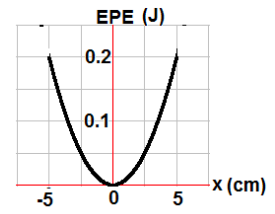
A 0.4 kg object is attached to a horizontal spring undergoes SHM with the total energy of 0.2 J. The potential energy as a function of position presented by the graph.
At time \( t = 0 \), a cart is at \( x = 10 \, \text{m} \) and has a velocity of \( 3 \, \text{m/s} \) in the \( -x \) direction. The cart has a constant acceleration in the \( +x \) direction with magnitude \( 3 \, \text{m/s}^2 < a < 6 \, \text{m/s}^2 \). Which of the following gives the possible range of the position of the cart at \( t = 1 \, \text{s} \)?

A massless rigid rod of length [katex]3d[/katex] is pivoted at a fixed point [katex]W[/katex], and two forces each of magnitude [katex]F[/katex] are applied vertically upward as shown above. A third vertical force of magnitude [katex]F[/katex] may be applied, either upward or downward, at one of the labeled points. With the proper choice of direction at each point, the rod can be in equilibrium if the third force of magnitude [katex]F[/katex] is applied at point?
A sphere of mass \(0.5\) \(\text{kg}\) is dropped into a column of oil. At the instant the sphere becomes completely submerged in the oil, the sphere is moving downward at \(8\) \(\text{m/s}\), the buoyancy force on the sphere is \(4.0\) \(\text{N}\), and the fluid frictional force is \(4.0\) \(\text{N}\). Which of the following describes the motion of the sphere at this instant?
By continuing you (1) agree to our Terms of Use and Terms of Sale and (2) consent to sharing your IP and browser information used by this site’s security protocols as outlined in our Privacy Policy.
Quick Start Guide
AP physics 1, AP C, honors and advanced physics students.
Quickly filter questions by units and more.
Here’s guide to using 5 UBQ filters.
GQ = general question, MCQ = multiple choice, FRQ = free response.
Click the check or bookmark button.
Now you’ll be able to see completed or bookmarked questions at a glance!
Answer keys, personalized for you.
Phy will be responsible for grading your FRQs and GQs.
No more copy and pasting. Just solve and snap.
Questions for Mastery
By continuing you agree to nerd-notes.com Terms of Service, Privacy Policy, and our usage of user data.