New Tool FRQ Atlas - Find, Solve, and Grade Any AP FRQ In Seconds.

Phy UBQ Count Message Here

for free to use all UBQ features

Advanced
Conceptual
MCQ

Consider the following cases of inelastic collisions.
Case (1) – A car moving at \(75 \, \text{mph}\) collides with another car of equal mass moving at \(75 \, \text{mph}\) in the opposite direction and comes to a stop.
Case (2) A car moving at \(75 \, \text{mph}\) hits a stationary steel wall and rolls back.
The collision time is the same for both cases. In which of these cases would result in the greatest impact force?

Intermediate
Mathematical
GQ

A bird, traveling at \(50 \, \text{m/s}\) wants to hit a man \(100 \, \text{m}\) below with a dropping. How far in distance before flying directly over the man should the bird release it?

Intermediate
Conceptual
MCQ

A friend is balancing a fork on one finger. Which of the following are correct explanations of how he accomplishes this? Select two answers.

Advanced
Mathematical
FRQ

A spherical balloon of mass \( 226 \) \( \text{kg} \) is filled with helium gas until its volume is \( 325 \) \( \text{m}^3 \). Assume the density of air is \( 1.29 \) \( \text{kg/m}^3 \) and the density of helium is \( 0.179 \) \( \text{kg/m}^3 \).

Beginner
Mathematical
GQ

A \( 7.3 \) \( \text{kg} \) mass is placed on a spring with a spring constant of \( 34 \) \( \text{N/cm} \). How much does this stretch the spring?

Beginner
Mathematical
MCQ

An old record player could bring a disk up to its \(45\) RPM speed in less than a second. If the same size disk can also be brought up to a speed of \(75\) RPM in about the same amount of time on another player. Compare the torques exerted by each record player.

Intermediate
Mathematical
GQ

The radius of the aorta is about \( 1 \) \( \text{cm} \) and the blood flowing through it has a speed of about \( 30 \) \( \frac{\text{cm}}{\text{s}} \). Calculate the average speed of the blood in the capillaries given the total cross section of all the capillaries is about \( 2000 \) \( \text{cm}^2 \).

Beginner
Mathematical
MCQ

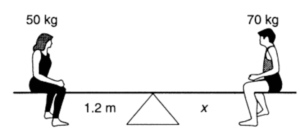
A \( 50 \, \text{kg} \) person is sitting on a seesaw \( 1.2 \, \text{m} \) from the balance point. On the other side, a \( 70 \, \text{kg} \) person is balanced. How far from the balance point is the second person sitting?
Advanced
Mathematical
GQ

A red car, initially at rest, travels east with an acceleration of \( 3.5 \, \text{m/s}^2 \). At the same time as the red car starts to move, a blue car is traveling west at \( 15 \, \text{m/s} \) and accelerating at \( 1.2 \, \text{m/s}^2 \). If they are \( 600 \, \text{m} \) apart the moment the red car starts to move and they are traveling towards each other, where and when will they meet?

Intermediate
Mathematical
MCQ

A solid plastic cube with uniform density (side length = \(0.5\) \(\text{m}\)) of mass \(100\) \(\text{kg}\) is placed in a vat of fluid whose density is \(1200\) \(\text{kg/m}^3\). What fraction of the cube’s volume floats above the surface of the fluid?

Beginner
Mathematical
GQ

A rotating, rigid body makes 10 complete revolutions in 10 seconds. What is its average angular velocity?

Advanced
Mathematical
FRQ

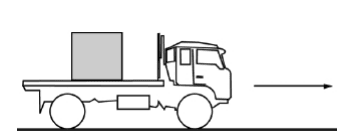
A \( 4700 \, \text{kg} \) truck carrying a \( 900 \, \text{kg} \) crate is traveling at \( 25 \, \text{m/s} \) to the right along a straight, level highway, as shown above. The truck driver then applies the brakes, and as it slows down, the truck travels \( 55 \, \text{m} \) in the next \( 3.0 \, \text{s} \). The crate does not slide on the back of the truck.


Intermediate
Mathematical
FRQ

A \(1.5 \, \text{kg}\) object is located at a distance of \(1.7 \times 10^{6} \, \text{m}\) from the center of a larger object whose mass is \(7.4 \times 10^{22} \, \text{kg}\).

Beginner
Conceptual
MCQ

An object is moving in the \( +x \) direction and begins to slow down. What must be true about its acceleration?

Beginner
Conceptual
MCQ

Can an object have a non-zero distance and zero average speed?

Intermediate
Conceptual
MCQ

In a controlled experiment, engineers test a firecracker. The firecracker has mass \( m \) and is placed at rest on a horizontal surface. When the firecracker is lit, it explodes and breaks apart into two pieces. In the first trial, one piece with mass \( \frac{m}{2} \) moves to the left with speed \( v_L \) and the other piece moves to the right with speed \( v_R \). A second trial is performed with an identical firecracker, and one piece with mass \( \frac{3m}{4} \) moves to the left, again with speed \( v_L \). What will the speed of the other piece be in this second trial?

Intermediate
Mathematical
FRQ

A spacecraft accelerates at a rate of \(20.0 \, \text{m/s}^2\).

Advanced
Conceptual
MCQ

A ladder at rest is leaning against a wall at an angle. Which of the following forces must have the same magnitude as the frictional force exerted on the ladder by the floor?

Beginner
Conceptual
MCQ

A car’s velocity increases as follows each second: \( 2 \) \( \text{m/s} \), \( 4 \) \( \text{m/s} \), \( 6 \) \( \text{m/s} \), \( 8 \) \( \text{m/s} \). This pattern shows that the car is:

Advanced
Mathematical
GQ

Suppose we wish to make a neutrally buoyant hollow sphere out of titanium (\(\rho = 4500 \text{kg/m}^3\)). If the sphere has an outer radius of \( 1.5 \) \( \text{m} \), what must be its inner radius?

Intermediate
Conceptual
MCQ

A bowling ball moving with speed \(v\) collides head-on with a stationary tennis ball. The collision is elastic and there is no friction. The bowling ball barely slows down. What is the speed of the tennis ball after the collision?

Beginner
Mathematical
FRQ
A car traveling at \( 20 \, \text{m/s} \) decelerates at a constant rate to a complete stop after traveling \( 40 \, \text{m} \).
Intermediate
Conceptual
MCQ

A point \( P \) is subjected to three simultaneous forces of magnitudes \( F_A > F_B > F_C \). Point \( P \) is in equilibrium. Which of the following statements is not always true about the magnitudes of the forces?

  1. \[ F_A = F_B + F_C \]
  2. \( F_A \leq F_B + F_C \)
  3. \( F_A > F_B – F_C \)
Advanced
Mathematical
GQ

The ultracentrifuge is an important tool for separating and analyzing proteins. Because of the enormous centripetal accelerations, the centrifuge must be carefully balanced, with each sample matched by a sample of identical mass on the opposite side. Any difference in the masses of opposing samples creates a net force on the shaft of the rotor, potentially leading to a catastrophic failure of the apparatus. Suppose a scientist makes a slight error in sample preparation and one sample has a mass \( 10 \) \( \text{mg} \) larger than the opposing sample.


If the samples are \( 12 \) \( \text{cm} \) from the axis of the rotor and the ultracentrifuge spins at \( 60000 \) \( \text{rpm} \), what is the magnitude of the net force on the rotor due to the unbalanced samples?

Nerd Notes

Discover the world's best Physics resources

Continue with

By continuing you (1) agree to our Terms of Use and Terms of Sale and (2) consent to sharing your IP and browser information used by this site’s security protocols as outlined in our Privacy Policy.

Sign In to View Your Questions

We use cookies to improve your experience. By continuing to browse on Nerd Notes, you accept the use of cookies as outlined in our privacy policy.