for free to use all UBQ features
On Earth, a simple pendulum of length \(1.2 \, \text{meters}\), mass of \(3 \, \text{kg}\), and amplitude of \(10\) degrees oscillates back and forth. Calculate:
An object is thrown upward at \( 65 \, \text{m/s} \) from the top of a \( 800 \, \text{m} \) tall building.
A fountain with an opening of radius \( 0.015 \) \( \text{m} \) shoots a stream of water vertically from ground level at \( 6.0 \) \( \text{m/s} \). The density of water is \( 1000 \) \( \text{kg/m}^3 \).
Runner A begins a \( 100 \)-meter race at time \( t = 0 \) and runs at a constant speed of \( 6.0 \) \( \text{m/s} \). Runner B starts the same race \( 3 \) seconds later but runs at \( 9.0 \) \( \text{m/s} \).
Water circulates throughout a house in a hot water heating system. If the water is pumped at a speed of \( 0.5 \) \( \frac{\text{m}}{\text{s}} \) through a \( 2 \) \( \text{cm} \) diameter pipe in the basement under a pressure of \( 3 \) \( \text{atm} \), what will be the flow speed and pressure in a \( 1.3 \) \( \text{cm} \) diameter pipe on the second floor \( 5 \) \( \text{m} \) above?
A race car travels in a circular track of radius \( 200 \) \( \text{m} \). If the car moves with a constant speed of \( 80 \) \( \text{m/s} \),

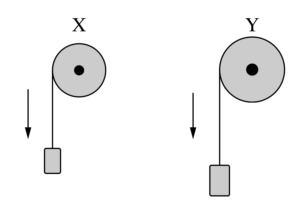
Pulleys \( X \) and \( Y \) are each attached to a block by a string that wraps around the pulley. Both blocks are released and have the same linear acceleration \( a \). As the blocks fall, the pulleys rotate about their centers. Pulley \( Y \) has a larger radius than Pulley \( X \). How does the angular acceleration \( \alpha_X \) of Pulley \( X \) compare to the angular acceleration \( \alpha_Y \) of Pulley \( Y \)?
A child on a sled reaches the bottom of a hill with a velocity of \( 10.0 \, \text{m/s} \) and travels \( 25.0 \, \text{m} \) along a horizontal straightaway to a stop. If the child and sled together have a mass of \( 60.0 \, \text{kg} \), what is the average retarding force on the sled on the horizontal straightaway?

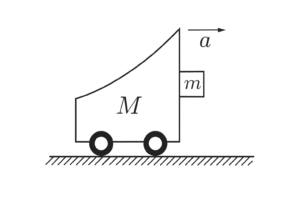
The figure above shows a cart of mass \( M \) accelerating to the right with acceleration \( a \). A block of mass \( m \) is pressed against the cart’s front vertical surface and is held there only by friction. The coefficient of friction between the block and the cart is \( \mu \). What is the minimum acceleration \( a \) of the cart such that the block will not fall?
One ball is dropped vertically from a window. At the same instant, a second ball is thrown horizontally from the same window. Which ball has the greater speed at ground level?
A skateboarder coasts to a stop on a flat sidewalk. The net force acting on the skateboarder must be ____.
When is the angular momentum of a system constant?
A \( 35 \) \( \text{kg} \) suitcase rests on a luggage‑loading ramp inclined \( 30.0^\circ \) above the horizontal. To keep it from sliding, a baggage‑handler pushes straight into the ramp (perpendicular to the surface) with a force of \( 45 \) \( \text{N} \). Find the coefficient of static friction \( \mu_s \) between the suitcase and the ramp.
Two points, A and B, are on a disk that rotates about an axis. Point A is \( 3 \) times as far from the axis as point B. If the speed of point B is \( v \), then what is the speed of point A?
Rex, an auto mechanic, is raising a \( 1200 \) \( \text{kg} \) car on his hydraulic lift so that he can work underneath. If the area of the input piston is \( 12.0 \) \( \text{cm}^2 \), while the output piston has an area of \( 700 \) \( \text{cm}^2 \), what force must be exerted on the input piston to lift the car?
A cube of unknown material and uniform density floats in a container of water with \(60\%\) of its volume submerged. If this same cube were placed in a container of oil with density \(800\) \(\text{kg/m}^3\), what portion of the cube’s volume would be submerged while floating?
A block with a mass of \( 4 \) \( \text{kg} \) is attached to a spring on the wall that oscillates back and forth with a frequency of \( 4 \) \( \text{Hz} \) and an amplitude of \( 3 \) \( \text{m} \). What would the frequency be if the block were replaced by one with one‑fourth the mass and the amplitude of the block is increased to \( 9 \) \( \text{m} \)?
A \(10 \, \text{meter}\) long pendulum on the earth, is set into motion by releasing it from a maximum angle of less than \(10^\circ\) relative to the vertical. At what time \(t\) will the pendulum have fallen to a perfectly vertical orientation?
Measurements made in 1910 indicate that the common flea is an impressive jumper, given its size. Assume that a flea’s initial speed is 2.1 m/s, and that it leaps at an angle of 21° with respect to the horizontal. The jump lasts 0.16 s.

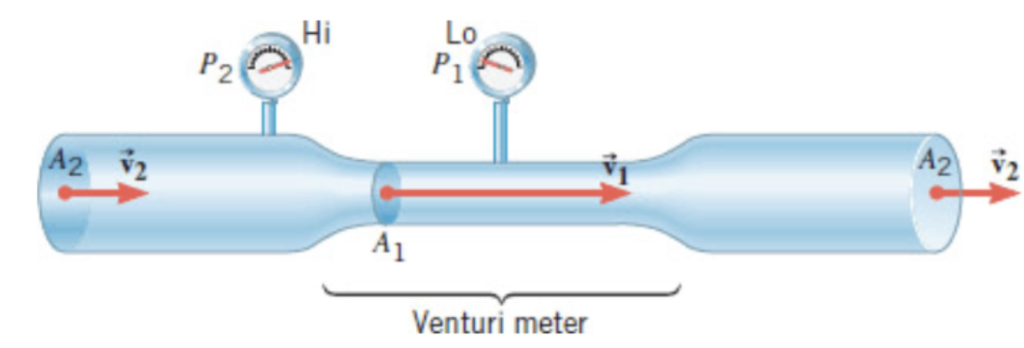
A Venturi meter is a device used for measuring the speed of a fluid within a pipe. The drawing shows a gas flowing at a speed \( v_2 \) through a horizontal section of pipe with a cross-sectional area \( A_2 = 542 \) \( \text{cm}^2 \). The gas has a density of \( 1.35 \) \( \text{kg/m}^3 \). The Venturi meter has a cross-sectional area of \( A_1 = 215 \) \( \text{cm}^2 \) and has been substituted for a section of the larger pipe. The pressure difference between the two sections \( P_2 – P_1 = 145 \) \( \text{Pa} \).

You have a giant cask of water with a spigot some height below the water surface. The surface of the water, which is essentially at rest, is exposed to atmosphere (\( \approx 10^5 \text{Pa} \)). The water density is \( \approx 1000 \text{kg/m}^3 \). The water pours out of the spigot at \( 3 \text{m/s} \). How far below the water surface is the spigot positioned?
Consider an object on a rotating disk at a distance \( r \) from its center, held in place on the disk by static friction. Which of the following statements is not true concerning this object?
A car with speed \( v \) and an identical car with speed \( 3v \) both travel the same circular section of an unbanked (flat) road. If the frictional force required to keep the faster car on the road without skidding is \( F \), then the frictional force required to keep the slower car on the road without skidding is
When the button of a trash compactor is pushed, a force of \( 350 \) \( \text{N} \) pushes down on a \( 1.3 \) \( \text{cm}^2 \) input piston, creating a force of \( 22,076 \) \( \text{N} \) to crush the trash. What is the area of the piston that crushes the trash?
By continuing you (1) agree to our Terms of Use and Terms of Sale and (2) consent to sharing your IP and browser information used by this site’s security protocols as outlined in our Privacy Policy.
Quick Start Guide
AP physics 1, AP C, honors and advanced physics students.
Quickly filter questions by units and more.
Here’s guide to using 5 UBQ filters.
GQ = general question, MCQ = multiple choice, FRQ = free response.
Click the check or bookmark button.
Now you’ll be able to see completed or bookmarked questions at a glance!
Answer keys, personalized for you.
Phy will be responsible for grading your FRQs and GQs.
No more copy and pasting. Just solve and snap.
Questions for Mastery
By continuing you agree to nerd-notes.com Terms of Service, Privacy Policy, and our usage of user data.