NewTry UBQ Quiz Lab. 40+ custom built quizzes to get a 5 on AP Physics 1.
for free to use all UBQ features
A \( 1.0 \, \text{kg} \) lump of clay is sliding to the right on a frictionless surface with a speed of \( 2 \, \text{m/s} \). It collides head-on and sticks to a \( 0.5 \, \text{kg} \) metal sphere that is sliding to the left with a speed of \( 4 \, \text{m/s} \). What is the kinetic energy of the combined objects after the collision?
A car can decelerate at \( -3.80 \, \text{m/s}^2 \) without skidding when coming to rest on a level road. What would its deceleration be if the road is inclined at \( 9.3^\circ \) and the car moves uphill? Assume the same static friction coefficient.

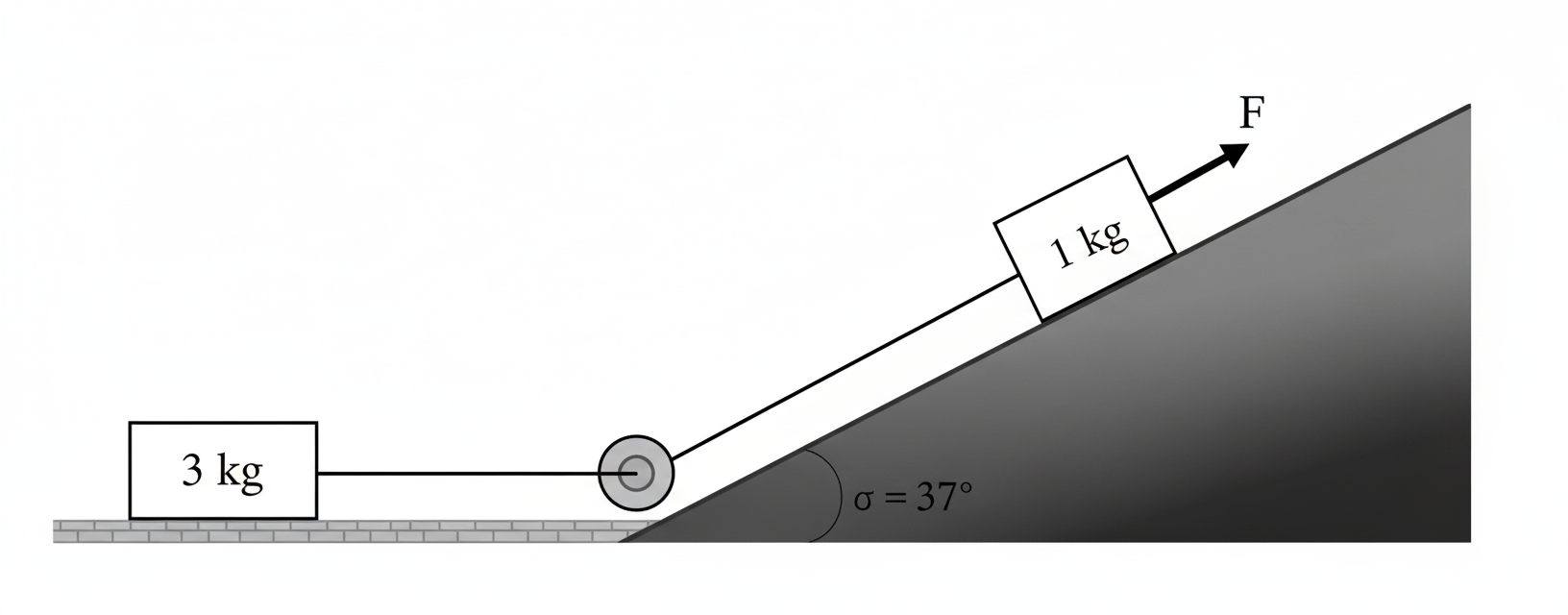
A \( 1 \) \( \text{kg} \) mass on a \( 37^{\circ} \) incline is connected to a \( 3.0 \) \( \text{kg} \) mass on a horizontal surface, as shown. The surfaces and the pulley are frictionless. If \( F = 12 \) \( \text{N} \):
A rubber ball and a piece of clay have equal masses. They are dropped from the same height on horizontal steel platform. The ball bounces back with nearly the same speed with which it hit. The clay sticks to the platform. Choose all that is true about the ball/platform and the clay/platform systems.
A car moving around a circular track with a constant speed has
Are astronauts really “weightless” while in orbit?

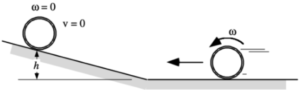
A hoop with a mass \(m\) and unknown radius is rolling without slipping on a flat surface with an angular speed \(\omega\). The hoop encounters a hill and continues to roll without slipping until it reaches a maximum height \(h\).
A rocket, initially at rest, is fired vertically upward with an acceleration of \( 12.0 \, \text{m/s}^2 \). At an altitude of \( 1.00 \, \text{km} \), the rocket engine cuts off. Drag is negligible.
An object is experiencing a nonzero net force. Which of the following statements is most accurate?
A turntable rotates through \( 6 \) \( \text{rad} \) in \( 3 \) \( \text{s} \) as it accelerates uniformly from rest. What is its angular acceleration in \( \text{rad/s}^2 \)?
A block attached to spring demonstrates simple harmonic motion about its equilibrium position with amplitude \( A \) and angular frequency \( \omega \). What is the maximum magnitude of the block’s velocity?
An object is thrown straight upward at 64 m/s.
On a distant planet, golf is just as popular as it is on Earth. A golfer tees off and drives the ball \(3.5\) times as far as he would have on Earth, given the same initial velocities on both planets. The ball is launched at a speed of \(45 \, \text{m/s}\) at an angle of \(29^\circ\) above the horizontal. When the ball lands, it is at the same level as the tee. On the distant planet find:
A pendulum has a period of \(2.0 \, \text{s}\) on Earth. What is its length?
A golf club exerts an average horizontal force of \(1000 \, \text{N}\) on a \(0.045 \, \text{kg}\) golf ball that is initially at rest on the tee. The club is in contact with the ball for \(1.8 \, \text{milliseconds}\). What is the speed of the golf ball just as it leaves the tee?
A student uses a pendulum to determine the acceleration due to gravity, \( g \). They measure the pendulum’s length \( L \) and its period \( T \). Which equation should they use to calculate \( g \)?
In which of the following is the particle’s acceleration constant?
A 2.00 x10² g block on a 50.0 cm long string swings in a circle on a horizontal, frictionless table at 75.0 rpm. What is the speed of block? What is the tension in the string?

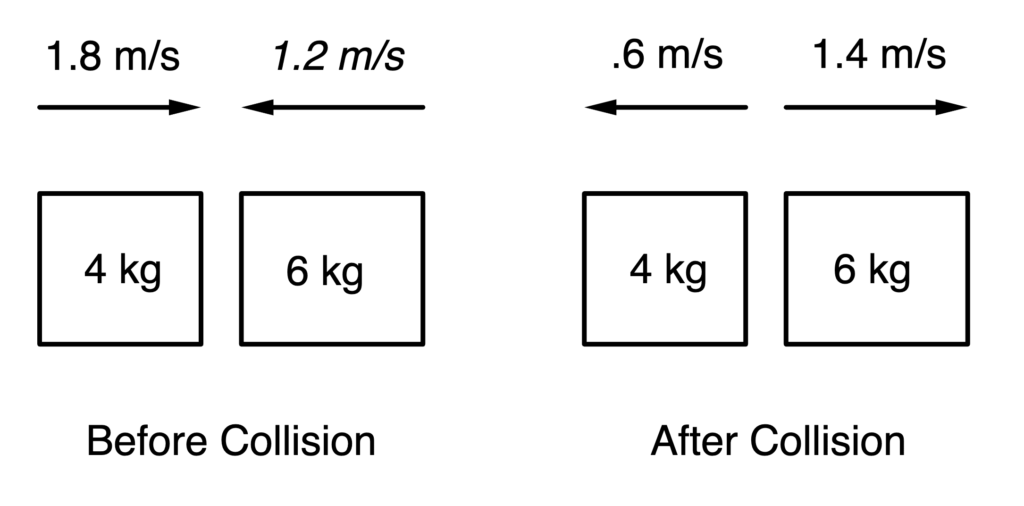
From the figure above, determine which characteristic fits this collision best.
A uniform solid sphere of mass M and radius R is placed on a frictionless horizontal surface. A massless string is wrapped around the sphere and is pulled with a force F. The string makes an angle of θ with the horizontal. What is the minimum value of the coefficient of static friction between the sphere and the surface required for the sphere to start rolling without slipping?
A \( 15 \) \( \text{N} \) force is pushing a \( 40 \) \( \text{N} \) block down a incline. The angle of the inline is \( \alpha = 40^{\circ} \). The coefficient of static friction between the block and the incline is \( \mu_s = 0.75 \) and the coefficient of kinetic friction is \( \mu_k = 0.65 \).
A horizontal uniform rod of length L and mass M is pivoted at one end and is initially at rest. A small ball of mass M (same masses) is attached to the other end of the rod. The system is released from rest. What is the angular acceleration of the rod just immediately after the system is released?

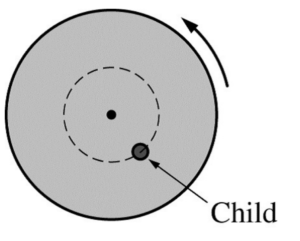
The diagram above shows a top view of a child of mass \(M\) on a circular platform of mass \(5M\)that is rotating counterclockwise. Assume the platform rotates without friction. Which of the following describes an action by the child that will result in an increase in the total angular momentum of the child-platform system?
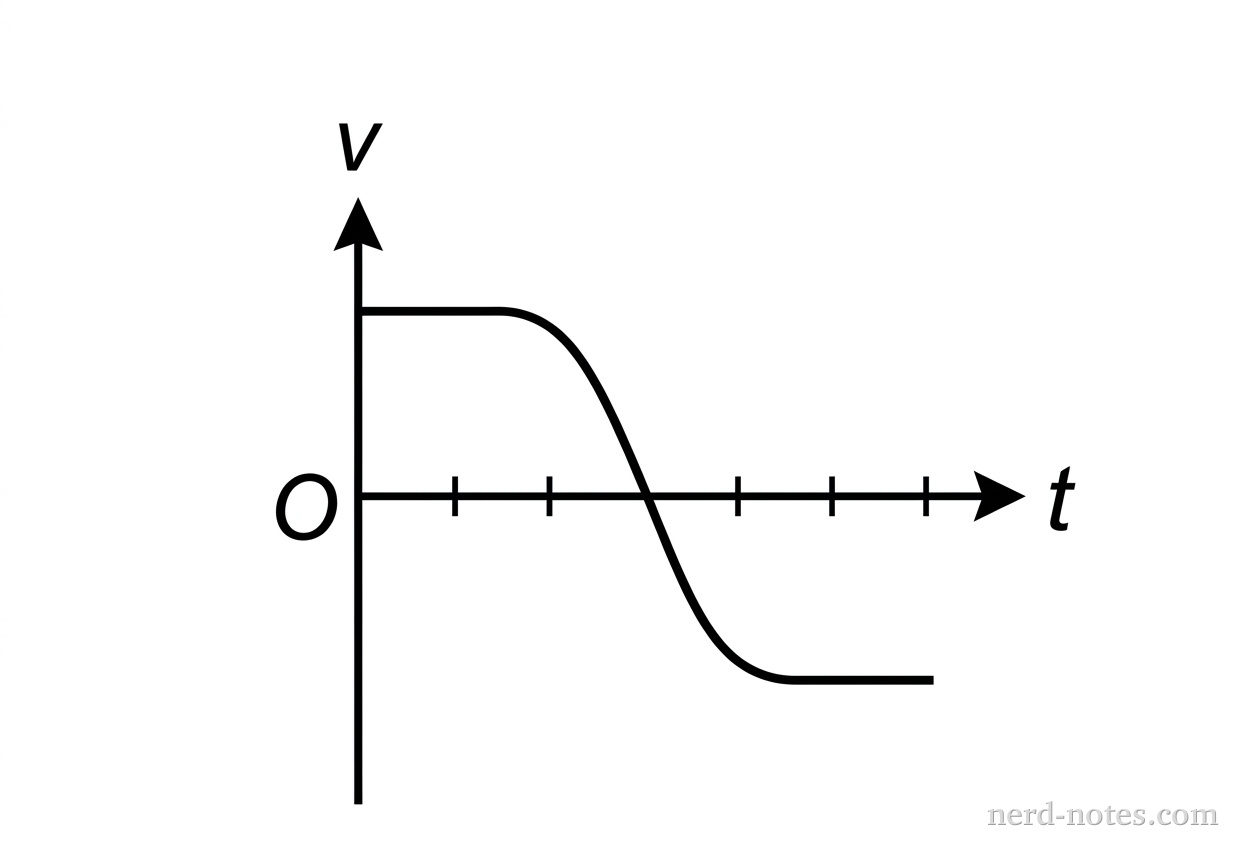
The graph above shows velocity \( v \) versus time \( t \) for an object in linear motion. Which of the following is a possible graph of position (\( x \)) versus time (\( t \)) for this object?

By continuing you (1) agree to our Terms of Use and Terms of Sale and (2) consent to sharing your IP and browser information used by this site’s security protocols as outlined in our Privacy Policy.
One price to unlock most advanced version of Phy across all our tools.
per month
Billed Monthly. Cancel Anytime.
Quick Start Guide
AP physics 1, AP C, honors and advanced physics students.
Quickly filter questions by units and more.
Here’s guide to using 5 UBQ filters.
GQ = general question, MCQ = multiple choice, FRQ = free response.
Click the check or bookmark button.
Now you’ll be able to see completed or bookmarked questions at a glance!
Answer keys, personalized for you.
Phy will be responsible for grading your FRQs and GQs.
No more copy and pasting. Just solve and snap.
Questions for Mastery
By continuing you agree to nerd-notes.com Terms of Service, Privacy Policy, and our usage of user data.