
for free to use all UBQ features
Which of the following situations will increase the moment of inertia of a solid cylinder \( I = \tfrac{1}{2} M R^{2} \) by the same amount?
How does the time t1 of a block m reaching the bottom of slide 1 compare with t2, the time taken block of mass 2m to reach the end of slide 2 that’s curved? The blocks are released from the same height.
Police officers have measured the length of a car’s tire skid marks to be \( 23 \, \text{m} \). This particular car is known to decelerate at a constant \( 7.5 \, \text{m/s}^2 \). What was the car’s initial velocity?
Consider a ball thrown up from the surface of the earth into the air at an angle of \( 30^\circ \) above the horizontal. Air resistance is negligible. The ball’s acceleration just after release is most nearly
The maximum acceleration a pilot can withstand without blacking out is about \( 7.0 \) \( g \). In an endurance test for a jet plane’s pilot, what is the maximum speed he can tolerate if he is spun in a horizontal circle of diameter \( 85 \) \( \text{m} \)?
A drinking fountain projects water at an initial angle of \( 50^ \circ \) above the horizontal, and the water reaches a maximum height of \( 0.150 \) \( \text{m} \) above the point of exit. Assume air resistance is negligible.
A blue ball is thrown upward with a velocity of \( 9 \) \( \text{m/s} \) upward from the top of a high cliff. At the same time, a red ball is dropped from the same spot. The red ball is observed to hit the ground below exactly \( 1 \) \( \text{s} \) before the blue ball. How high is the cliff?
A \( 1.0 \, \text{kg} \) lump of clay is sliding to the right on a frictionless surface with a speed of \( 2 \, \text{m/s} \). It collides head-on and sticks to a \( 0.5 \, \text{kg} \) metal sphere that is sliding to the left with a speed of \( 4 \, \text{m/s} \). What is the kinetic energy of the combined objects after the collision?
An ice sled powered by a rocket engine starts from rest on a large frozen lake and accelerates at \( +13.0 \, \text{m/s}^2 \). At \( t_1 \), the rocket engine is shut down and the sled moves with constant velocity \( v \) until \( t_2 \). The total distance traveled by the sled is \( 5.30 \times 10^3 \, \text{m} \) and the total time is \( 90.0 \, \text{s} \).
A student is designing an experiment to find the spring constant \( k \) of a spring using only a set of known masses and a stopwatch. Which procedure would work?

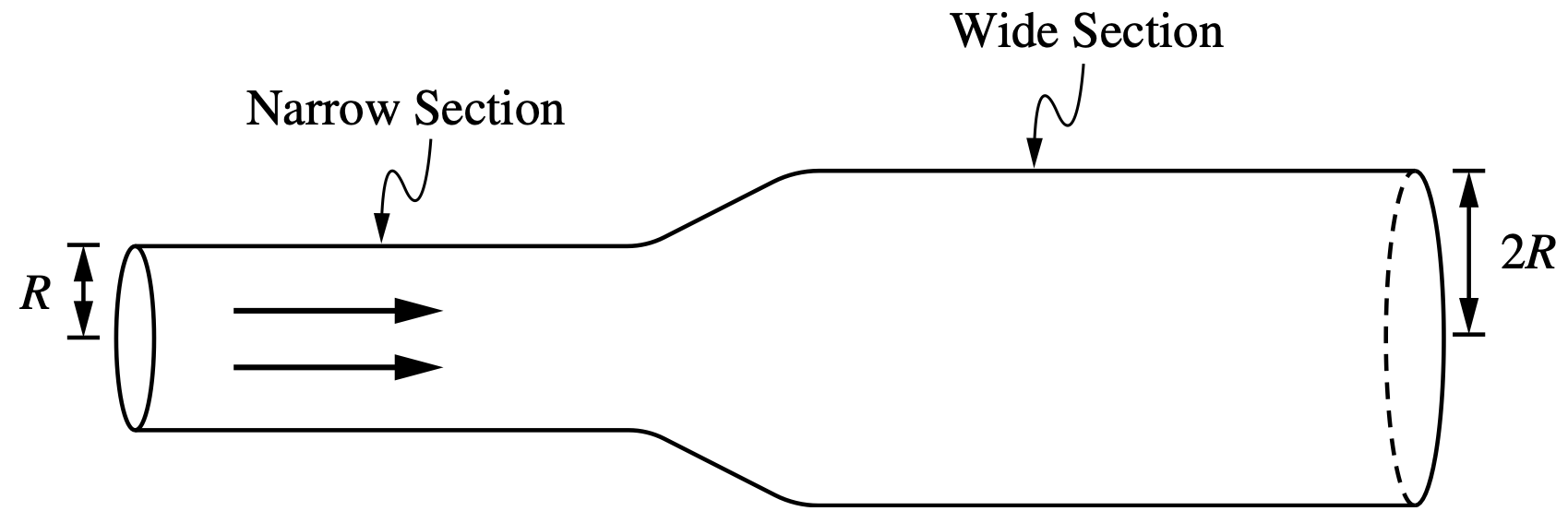
A fluid flows through the two sections of cylindrical pipe shown in the figure. The narrow section of the pipe has radius \( R \) and the wide section has radius \( 2R \). What is the ratio of the fluid’s speed in the wide section of pipe to its speed in the narrow section of pipe, \( \frac{v_{\text{wide}}}{v_{\text{narrow}}} \)?
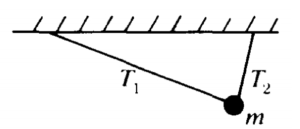
A ball of mass \( m \) is suspended from two strings of unequal length as shown above. The magnitudes of the tensions \( T_1 \) and \( T_2 \) in the strings must satisfy which of the following relations?
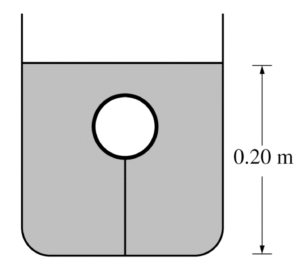
A beaker weighing \( 2.0 \) \( \text{N} \) is filled with \( 5.0 \times 10^{-3} \) \( \text{m}^3 \) of water. A rubber ball weighing \( 3.0 \) \( \text{N} \) is held entirely underwater by a massless string attached to the bottom of the beaker, as represented in the figure above. The tension in the string is \( 4.0 \) \( \text{N} \). The water fills the beaker to a depth of \( 0.20 \) \( \text{m} \). Water has a density of \( 1000 \) \( \text{kg/m}^3 \). The effects of atmospheric pressure may be neglected.
Two people, one of mass \( 88 \) \( \text{kg} \) and the other of mass \( 55 \) \( \text{kg} \), sit in a rowboat of mass \( 70 \) \( \text{kg} \). With the boat initially at rest, the two people, who have been sitting at opposite ends of the boat \( 3.1 \) \( \text{m} \) apart from each other, now exchange seats.
Two identical satellites are placed in orbit of two different planets. Satellite \(A\) orbits Mars, and Satellite \(B\) orbits Jupiter. The orbital speeds of each satellite are the same. Which satellite has a greater orbital radius?
In a 4.0-kilometer race, a runner completes the first kilometer in 5.9 minutes, the second kilometer in 6.2 minutes, the third kilometer in 6.3 minutes, and the final kilometer in 6.0 minutes. What is the average speed of the runner? Use standard units: m/s.
Priscilla the Penguin stands at the edge of a rock ledge and tosses a small ice cube directly upward with an initial velocity of \( v_0 \). The ice cube’s initial height above the ground is \( 3.25 \, \text{m} \), and it reaches its maximum height above the ground \( 0.586 \, \text{s} \) after being thrown. The ice cube then plummets to the ground, missing the edge of the rock ledge on its way down.
A firecracker in a coconut blows the coconut into three pieces. Two pieces of equal mass fly off south and west, perpendicular to each other, at \( 18 \) \( \text{m/s} \). The third piece has \( 2.5 \) times the mass as the other two.
A \( 25.0 \) \( \text{kg} \) block is placed at the top of an inclined plane set at an angle of \( 35 \) degrees to the horizontal. The block slides down the \( 1.5 \) \( \text{m} \) slope at a constant rate. How much work did friction do on the block?
A skater glides across the ice at a constant \( 6 \) \( \text{m/s} \). After \( 4 \) \( \text{s} \), friction gradually slows them down until they come to rest in \( 6 \) \( \text{s} \). They pause for \( 2 \) \( \text{s} \), then push off in the opposite direction, steadily gaining speed for \( 5 \) \( \text{s} \). Draw the velocity vs. time graph.
A projectile is fired with an initial speed of \( 36.6 \) \( \text{m/s} \) at an angle of \( 42.2^\circ \) above the horizontal on a long flat firing range.
A \( 50 \) \( \text{g} \) ice cube can slide up and down a frictionless \( 30^{\circ}\) slope. At the bottom, a spring with spring constant \( 25 \) \( \text{N/m} \) is compressed \( 10 \) \( \text{cm} \) and is used to launch the ice cube up the slope. How high does it go above its starting point? Express your answer with the appropriate units.
Two students push a \(1750\, \mathrm{kg}\) car with a force of \(758\, \mathrm{N}\) along a perfectly level road at a constant velocity of \(4.00\, \mathrm{m/s}\). Find the force of friction.
A solid sphere, solid cylinder, and a hollow pipe all have equal masses and radii. If the three of them are released simultaneously at the top of an inclined plane and do not slip, which one will reach the bottom first? [katex] I_{sphere} = \frac{2}{5}MR^2[/katex], [katex] I_{cylinder} = \frac{1}{2}MR^2[/katex], [katex] I_{pipe} = MR^2[/katex]
By continuing you (1) agree to our Terms of Use and Terms of Sale and (2) consent to sharing your IP and browser information used by this site’s security protocols as outlined in our Privacy Policy.
Quick Start Guide
AP physics 1, AP C, honors and advanced physics students.
Quickly filter questions by units and more.
Here’s guide to using 5 UBQ filters.
GQ = general question, MCQ = multiple choice, FRQ = free response.
Click the check or bookmark button.
Now you’ll be able to see completed or bookmarked questions at a glance!
Answer keys, personalized for you.
Phy will be responsible for grading your FRQs and GQs.
No more copy and pasting. Just solve and snap.
Questions for Mastery
By continuing you agree to nerd-notes.com Terms of Service, Privacy Policy, and our usage of user data.