for free to use all UBQ features
Young David experimented with slings before tackling Goliath. He found that he could develop an angular speed of \( 8.0 \) \( \text{rev/s} \) in a sling \( 0.60 \) \( \text{m} \) long. If he increased the length to \( 0.90 \) \( \text{m} \), he could revolve the sling only \( 6.0 \) times per second.

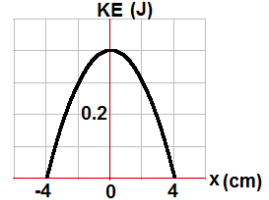
A 0.2 kg object is attached to a horizontal spring undergoes SHM with the total energy of 0.4 J. The kinetic energy as a function of position presented by the graph.
An object is thrown downward at \(23 ~\text{m/s}\) from the top of a \(200 ~\text{m}\) tall building.

Alcohol has a specific gravity of \( 0.79 \). If a barometer consisting of an open-ended tube placed in a dish of alcohol is used at sea level, to what height in the tube will the alcohol rise?
A uniform, solid, \( 100 \) \( \text{kg} \) cylinder with a diameter of \( 1.0 \) \( \text{m} \) is mounted so it is free to rotate about a fixed, horizontal, frictionless axis that passes through the centers of its circular ends. A \( 10 \) \( \text{kg} \) block is hung from a very light, thin cord wrapped around the cylinder’s circumference. When the block is released, the cord unwinds and the block accelerates downward. What is the acceleration of the block?
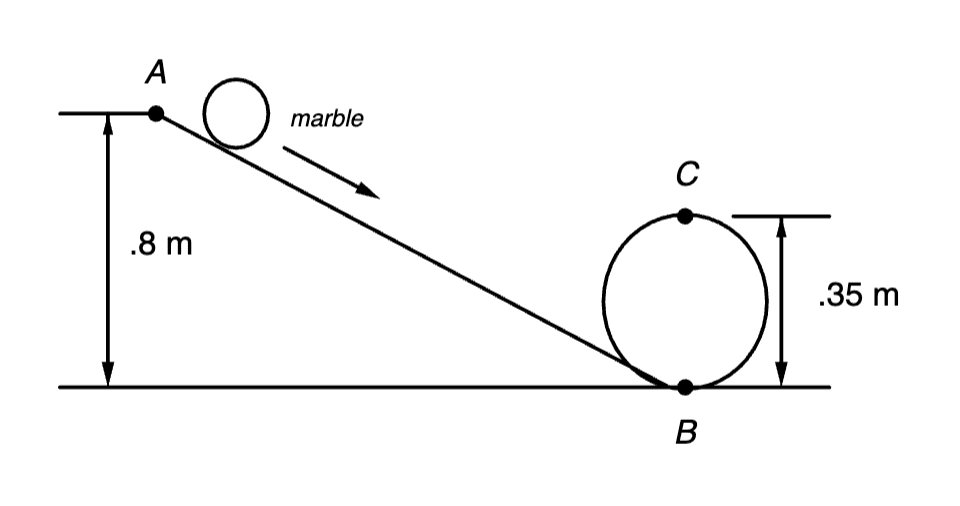
The diagram above shows a marble rolling down an incline, the bottom part of which has been bent into a loop. The marble is released from point A at a height of \(0.80 \, \text{m}\) above the ground. Point B is the lowest point and point C the highest point of the loop. The diameter of the loop is \(0.35 \, \text{m}\). The mass of the marble is \(0.050 \, \text{kg}\). Friction forces and any gain in kinetic energy due to the rotating of the marble can be ignored. When answering the following questions, consider the marble when it is at point C.
Why do you push down harder on the pedals of a bicycle when first starting out than when moving at constant speed? Why do you need to pedal at all when cycling at constant speed?
A rollercoaster leaves the station at rest. Its speed increases steadily for \( 6 \) \( \text{s} \) as it heads down the first drop. The ride then levels out and it moves at a constant speed for \( 4 \) \( \text{s} \) before hitting the brakes and stopping in \( 3 \) \( \text{s} \). Draw the velocity vs. time graph or explain it in terms of functions.
A pendulum consists of a mass \( M \) hanging at the bottom end of a massless rod of length \( \ell \) which has a frictionless pivot at its top end. A mass \( m \), moving with velocity \( v \), impacts \( M \) and becomes embedded. In terms of the given variables and constants, what is the smallest value of \( v \) sufficient to cause the pendulum (with embedded mass \( m \)) to swing clear over the top of its arc?
The steepest street in the world is Baldwin Street in Dunedin, New Zealand. It has an inclination angle of \( 38.0^\circ \) with respect to the horizontal. Suppose a wooden crate with a mass of \( 25.0 \) \( \text{kg} \) is placed on Baldwin Street. An additional force of \( 59 \) \( \text{N} \) must be applied to the crate perpendicular to the pavement in order to hold the crate in place. If the coefficient of static friction between the crate and the pavement is \( 0.599 \), what is the magnitude of the frictional force?
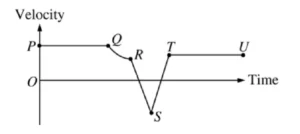
The graph above shows velocity as a function of time for an object moving along a straight line. For which of the following sections of the graph is the acceleration constant and nonzero?
What force would have to be applied to start a \(12.3 \, \text{kg}\) wood block moving on a surface with a static coefficient of friction of \(0.438\)?
A baseball is thrown vertically into the air with a velocity \( v \), and reaches a maximum height \( h \). At what height was the baseball moving with one-half its original velocity? Assume air resistance is negligible.
A \( 15 \) \( \text{N} \) force is pushing a \( 40 \) \( \text{N} \) block down a incline. The angle of the inline is \( \alpha = 40^{\circ} \). The coefficient of static friction between the block and the incline is \( \mu_s = 0.75 \) and the coefficient of kinetic friction is \( \mu_k = 0.65 \).

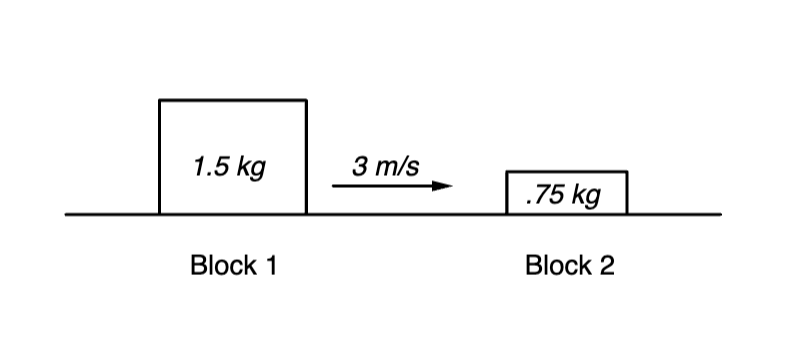
Block 2 initially is at rest. Block 1 travels towards block 2 and collides with Block 2 as shown above. Find the final velocities of both blocks assuming the collision is elastic.
One end of a spring is attached to a solid wall while the other end just reaches to the edge of a horizontal, frictionless tabletop, which is a distance \(h\) above the floor. A block of mass \(M\) is placed against the end of the spring and pushed toward the wall until the spring has been compressed a distance \(x\). The block is released and strikes the floor a horizontal distance \(D\) from the edge of the table. Air resistance is negligible. Derive expressions for the following quantities only in terms of \(M, x, D, h,\) and any constants.
You pull a box with a constant force across a frictionless table using an attached rope held horizontally. If you now pull the rope with the same force at an angle to the horizontal (with the box remaining flat on the table). Does the acceleration of the box increase, decrease, or remain the same if the rope is pulled at an angle? Explain.

The graph above shows the angular velocity of a spinning wheel (radius = \( 25 \) \( \text{cm} \)) as a function of time.
A \(350\ \text{g}\) ball is attached to the end of a thin, uniform rod of mass \(500\ \text{g}\) and length \(1.2\ \text{m}\). The system is rotated in a horizontal circle about the opposite end of the rod. Calculate the moment of inertia of the system about the axis of rotation. Hint: the moment of inertia of a thin rod about the end of the rod is \(I = \tfrac{1}{3} m L^2\).
Car A, mass 1000 kg, is traveling at 40 m/s when it collides with a stationary car B. They stick together and travel at 7 m/s. What is the mass of car B?

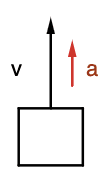
The box is sitting on the floor of an elevator. The elevator is accelerating upward. The magnitude of the normal force on the box is
You throw a rock straight up with an initial velocity of \( 5.0 \, \text{m/s} \).
By continuing you (1) agree to our Terms of Use and Terms of Sale and (2) consent to sharing your IP and browser information used by this site’s security protocols as outlined in our Privacy Policy.
Quick Start Guide
AP physics 1, AP C, honors and advanced physics students.
Quickly filter questions by units and more.
Here’s guide to using 5 UBQ filters.
GQ = general question, MCQ = multiple choice, FRQ = free response.
Click the check or bookmark button.
Now you’ll be able to see completed or bookmarked questions at a glance!
Answer keys, personalized for you.
Phy will be responsible for grading your FRQs and GQs.
No more copy and pasting. Just solve and snap.
Questions for Mastery
By continuing you agree to nerd-notes.com Terms of Service, Privacy Policy, and our usage of user data.