
Unit 8.2 | Buoyancy and Archimedes’ Principle
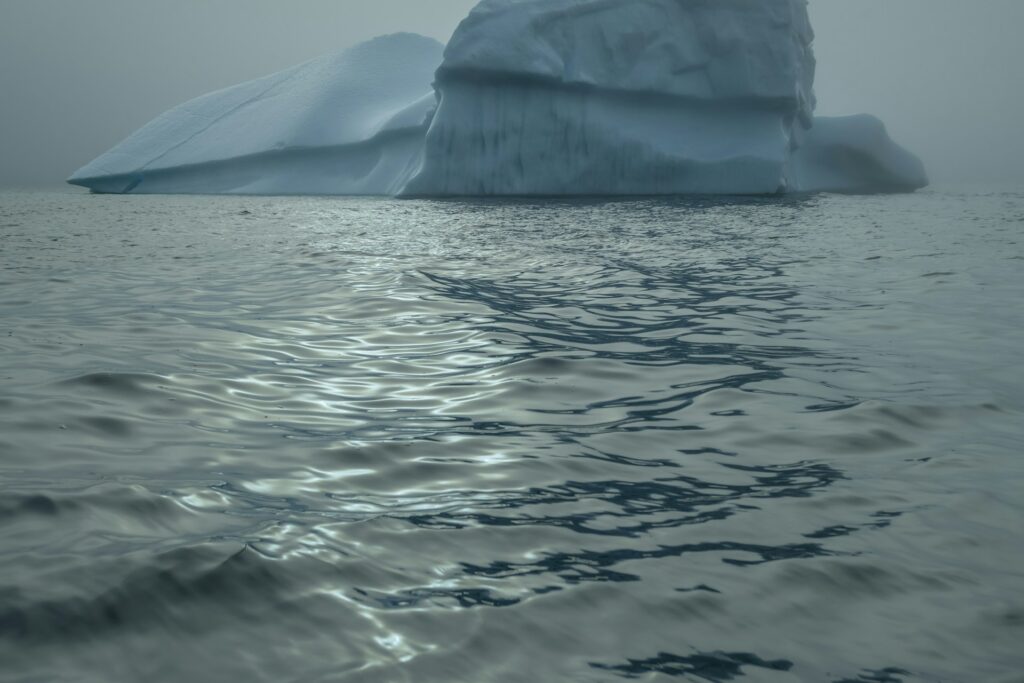
- 17 minutes
- 1 formulas
- 24 questions
- 4 videos

Why do ships float and rocks feel lighter underwater? The buoyant force, F_B = ρVg, and four problem types that cover every buoyancy question.
Unit 8 Breakdown
In this lesson:
- Where the buoyant force comes from: the fluid pushes harder on the deeper side
- Archimedes’ principle: [katex] F_B = \rho_f V_{sub}\, g [/katex], the weight of the displaced fluid
- Float or sink: compare densities, and find how much of a floating object sits underwater
- The 4 problem types: floating objects, weighing underwater, comparing buoyant forces, and held, released and lifted
Introduction
This lesson covers buoyancy and Archimedes’ principle: the upward push a fluid gives anything placed in it, and how to use it with Newton’s laws.
In Unit 8.1 you saw that pressure grows with depth. Put an object in a fluid and its bottom is deeper than its top, so the fluid pushes up harder than it pushes down. That difference is the buoyant force. After that, every problem is a free-body diagram from Unit 2 with one extra force.
Where the Buoyant Force Comes From
Take a block of height [katex] \Delta h [/katex] and face area [katex] A [/katex], fully under water:
- The fluid pushes down on the top face with [katex] P_{top}A [/katex] and up on the bottom face with [katex] P_{bottom}A [/katex]. The pushes on the sides cancel.
- The pressure difference between the faces is [katex] P_{bottom} – P_{top} = \rho_f g\,\Delta h [/katex] (Unit 8.1).
- So the net upward force is [katex] F_B = \rho_f g\,\Delta h\,A = \rho_f V g [/katex], because [katex] \Delta h\,A [/katex] is the block’s volume.
Archimedes’ Principle
[katex] F_B = \rho_f V_{sub}\, g [/katex]
The buoyant force equals the weight of the fluid the object pushes out of the way. [katex] \rho_f [/katex] is the density of the fluid, not the object, and [katex] V_{sub} [/katex] is the volume of the object that is under the surface. For a fully submerged object, [katex] V_{sub} [/katex] is its whole volume.
▶ Watch: Archimedes’ principle, worked from scratch (starts at 9:01).
The buoyant force does not depend on the object’s mass, its material or how deep it is (once it is fully under). An aluminum ball and a lead ball of the same size feel the same buoyant force.
Float or Sink?
A fully submerged object of density [katex] \rho_o [/katex] has weight [katex] \rho_o V g [/katex] and buoyant force [katex] \rho_f V g [/katex]. Compare them and only the densities are left:
| Densities | What happens |
| [katex] \rho_o > \rho_f [/katex] | Sinks: the weight beats the largest possible buoyant force |
| [katex] \rho_o = \rho_f [/katex] | Neutrally buoyant: stays at any depth |
| [katex] \rho_o < \rho_f [/katex] | Rises, then floats with only part of it under |
A steel ship floats because its average density, steel plus all the air inside the hull, is less than water’s.
Every buoyancy question on the AP exam is one of the four types below. In each one, start with a free-body diagram.
| Problem type | The clue | The setup |
| 1. Floating objects | “floats”, “what fraction is submerged” | [katex] F_B = mg [/katex], so [katex] \frac{V_{sub}}{V} = \frac{\rho_o}{\rho_f} [/katex] |
| 2. Weighing underwater | a spring scale, string tension, “apparent weight” | [katex] T + F_B = mg [/katex] |
| 3. Comparing buoyant forces | two objects or two fluids, “which has the greater buoyant force” | Compare [katex] \rho_f [/katex] and [katex] V_{sub} [/katex] only |
| 4. Held, released and lifted | pushed under, let go, balloons, a scale under the container | [katex] \sum F = ma [/katex] with [katex] F_B [/katex] as one force |
Problem Type 1: Floating objects
How to spot it: Something “floats”, “floats at rest”, or the question asks what fraction or how much of it is below the surface.
Setup: Floating at rest means [katex] F_B = mg [/katex], so [katex] \rho_f V_{sub}\,g = \rho_o V g [/katex]. The fraction under water is [katex] \frac{V_{sub}}{V} = \frac{\rho_o}{\rho_f} [/katex].
A wooden block [katex] 0.40\,\text{m} [/katex] × [katex] 0.40\,\text{m} [/katex] × [katex] 0.20\,\text{m} [/katex] (density [katex] 600\,\text{kg/m}^3 [/katex]) floats flat in water. How deep does its bottom sit, and how much mass can you stack on top before the block goes completely under?
Fraction under: [katex] \frac{600}{1000} = 0.60 [/katex], so [katex] (0.60)(0.20) = 0.12 \text{ m} [/katex] of its height is under water. The block has [katex] V = 0.032 \text{ m}^3 [/katex] and [katex] m = (600)(0.032) = 19.2 \text{ kg} [/katex]. Fully under, the buoyant force can hold [katex] \rho_f V = (1000)(0.032) = 32 \text{ kg} [/katex], so you can add [katex] 32 – 19.2 = 12.8 \text{ kg} [/katex].
▶ Watch: floating and sinking from the forces (starts at 15:13).
AP trap: Using the object’s density in [katex] F_B = \rho V g [/katex], or using the whole volume of a floating object. The buoyant force uses the fluid’s density and only the submerged volume.
Accounts are free! Log in to try this question, see explanations, save progress, and more!
Accounts are free! Log in to try this question, see explanations, save progress, and more!
Accounts are free! Log in to try this question, see explanations, save progress, and more!
Problem Type 2: Weighing underwater: tension and apparent weight
How to spot it: An object hangs from a spring scale or string while under water: “the scale reads”, “apparent weight”, “tension in the cord”.
Setup: Free-body diagram: [katex] T [/katex] and [katex] F_B [/katex] up, [katex] mg [/katex] down. At rest, [katex] T + F_B = mg [/katex], so the scale reads [katex] T = mg – \rho_f V g [/katex]. The drop in the reading is the buoyant force.
A [katex] 2.0\,\text{kg} [/katex] rock with a volume of [katex] 8.0 \times 10^{-4} \text{ m}^3 [/katex] hangs from a spring scale, completely under water. What does the scale read?
Weight: [katex] (2.0)(9.8) = 19.6 \text{ N} [/katex]. Buoyant force: [katex] F_B = (1000)(8.0 \times 10^{-4})(9.8) \approx 7.8 \text{ N} [/katex]. Scale: [katex] T = 19.6 – 7.8 \approx 11.8 \text{ N} [/katex]. The rock “weighs” 40% less under water.
Lowering the rock into the water
AP trap: Adding the buoyant force to the weight, or forgetting it. The scale reading is the weight minus the buoyant force.
Accounts are free! Log in to try this question, see explanations, save progress, and more!
Accounts are free! Log in to try this question, see explanations, save progress, and more!
Accounts are free! Log in to try this question, see explanations, save progress, and more!
Accounts are free! Log in to try this question, see explanations, save progress, and more!
Problem Type 3: Comparing buoyant forces
How to spot it: Two objects, two fluids, or two depths: “which buoyant force is greater”, “how does the buoyant force change”, ratios.
Setup: Ignore what the object is made of. The buoyant force depends only on [katex] \rho_f [/katex] and [katex] V_{sub} [/katex]. If an object floats, its buoyant force equals its weight instead.
Two balls have the same volume. A wooden one floats with 60% of its volume under water. A steel one rests on the bottom of the pool. Which has the greater buoyant force, and by what factor?
The steel ball is fully under, so it displaces [katex] V [/katex]. The wooden ball displaces only [katex] 0.60V [/katex]. So the steel ball has the greater buoyant force, by [katex] \frac{1}{0.60} \approx 1.7 [/katex] times. It still sinks because its weight is far greater.
AP trap: Thinking a floating object has more buoyant force than a sinking one. Floating only means the buoyant force matches the weight. A sunken object often has the larger buoyant force; it just has an even larger weight.
Accounts are free! Log in to try this question, see explanations, save progress, and more!
Accounts are free! Log in to try this question, see explanations, save progress, and more!
Accounts are free! Log in to try this question, see explanations, save progress, and more!
Accounts are free! Log in to try this question, see explanations, save progress, and more!
Problem Type 4: Held, released and lifted: Newton’s laws with buoyancy
How to spot it: An object is pushed under and released, a balloon lifts a load, something sinks or rises with an acceleration, or a scale sits under the container.
Setup: Draw the free-body diagram with [katex] F_B [/katex] as one more force and use [katex] \sum F = ma [/katex]. Newton’s third law: the object pushes down on the fluid with a force equal to [katex] F_B [/katex].
A [katex] 0.50\,\text{kg} [/katex] ball with a volume of [katex] 2.0 \times 10^{-3} \text{ m}^3 [/katex] is held completely under water. How hard must you push to hold it there, and what is its acceleration just after you let go? (Ignore drag.)
Buoyant force: [katex] (1000)(2.0 \times 10^{-3})(9.8) = 19.6 \text{ N} [/katex]. Weight: [katex] (0.50)(9.8) = 4.9 \text{ N} [/katex]. To hold it: [katex] F_{push} = 19.6 – 4.9 = 14.7 \text{ N} [/katex] down. Let go and that push is gone: [katex] a = \frac{19.6 – 4.9}{0.50} \approx 29 \text{ m/s}^2 [/katex] upward.
▶ Watch: the forces framework this type uses, step by step.
A beaker of water sits on a scale and a hanging object is lowered into it. The water pushes up on the object with [katex] F_B [/katex], so the object pushes down on the water with [katex] F_B [/katex], and the scale reading goes up by exactly [katex] F_B [/katex].
AP trap: Keeping the pushing force after the object is released, or leaving out the third-law pair. The force on the water is equal and opposite to the buoyant force, not to the object’s weight (unless it floats).
Accounts are free! Log in to try this question, see explanations, save progress, and more!
Accounts are free! Log in to try this question, see explanations, save progress, and more!
Accounts are free! Log in to try this question, see explanations, save progress, and more!
Accounts are free! Log in to try this question, see explanations, save progress, and more!
Lesson 8.3 Preview
So far the fluid has been at rest. In the next lesson it starts to flow, and one rule, the continuity equation, explains why water speeds up when you squeeze the end of a hose.
Accounts are free! Log in to read the rest, try the practice questions, and save your progress.
This article was written by Jason